
All News
All News
How to Choose a PTO Log Splitter: Splitting Force, Log Size & Tractor Compatibility
Choosing the right PTO log splitter depends on more than splitting force. Buyers should compare log size, cycle time, machine weight, tractor compatibility and shipping requirements before choosing a model. For dealers and importers, these differences also affect local market positioning, warehouse handling, container loading and landed cost.
Before selecting a model, compare:
· Splitting force
· Maximum log length and diameter
· Cycle time
· Hydraulic cylinder size
· Machine weight
· Tractor and PTO compatibility
· Packing dimensions and container loading
The right combination depends on the logs being processed, the tractor being used and, for distributors, the requirements of the local market.
Splitting force indicates how much force the machine can apply during the splitting process. However, higher tonnage does not automatically make a model more suitable for every application.
The LEFA LF18T-PTO provides 18 tons of splitting force, while the LF22T-PTO provides 22 tons. A more useful buying question is not simply “Which model has more splitting force?” but “What size logs do I actually need to split?”
Log dimensions are one of the clearest ways to distinguish the two models:
MODEL | MAX. LOG LENGTH | MAX. LOG DIAMETER |
LF18T-PTO | 520 mm | 350 mm |
LF22T-PTO | 1,050 mm | 350 mm |
Key takeaway: the main difference in splitting capacity is log length, not log diameter. Both models have a stated maximum log diameter of 350 mm, while the LF22T-PTO extends maximum log length from 520 mm to 1,050 mm.
For buyers mainly processing shorter firewood, the LF18T-PTO may meet their requirements. For applications involving substantially longer logs, the LF22T-PTO provides the longer stated splitting capacity.
SPECIFICATION | LF18T-PTO | LF22T-PTO |
Splitting Force | 18 ton | 22 ton |
Max. Log Length | 520 mm | 1,050 mm |
Max. Log Diameter | 350 mm | 350 mm |
Cylinder Inner Diameter | 75 mm | 90 mm |
Cylinder Length | 600 mm | 1,000 mm |
Cycle Time | 17–20 s | 17–24 s |
Tire Size | 8" | 16" |
Net Weight | 105 kg | 210 kg |
Gross Weight | 122 kg | 225 kg |
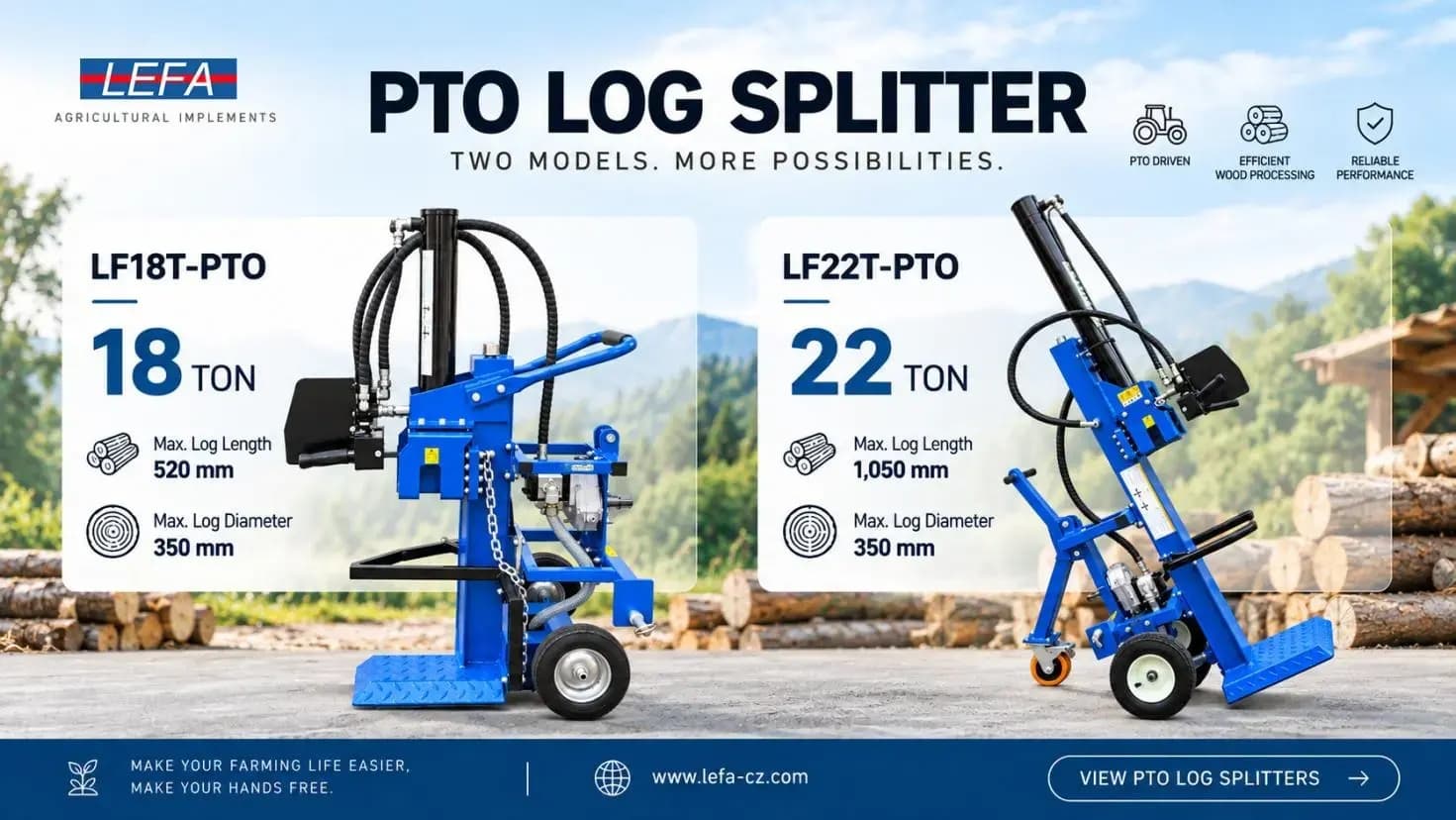
The LF18T-PTO is the lighter and more compact option, with a net weight of 105 kg and a maximum stated splitting length of 520 mm. The LF22T-PTO increases splitting force to 22 tons, extends maximum log length to 1,050 mm and has a net weight of 210 kg.
The choice between the two models should therefore be based on log dimensions, tractor compatibility, machine handling and the intended application—not tonnage alone.
Yes. The LF18T-PTO has a stated cycle time of 17–20 seconds, while the LF22T-PTO is 17–24 seconds. Cycle time is one factor that can affect working efficiency, but it should be considered together with log capacity, splitting force and the intended workload rather than used as the only measure of productivity.
A tractor PTO log splitter should always be checked against the tractor that will power it. Before ordering, buyers should provide their tractor model and PTO specifications so compatibility can be confirmed.
Important: recommended tractor horsepower and PTO speed were not included in the product specifications used for this guide. These details should therefore be confirmed according to the final machine configuration before ordering.
Start with the type and size of logs commonly processed in your market. Are customers mainly handling shorter firewood, or do they regularly need to split longer logs? This helps determine whether an 18 ton model, a 22 ton model or a mix of capacities better fits local demand.
For distributors, machine weight is also relevant to warehouse handling and logistics. The LF18T-PTO has a stated net weight of 105 kg, compared with 210 kg for the LF22T-PTO. For bulk orders, machine size, weight, packing method and quantity can all affect shipping arrangements and landed cost.
For a first dealer order, selecting only the model with the highest splitting force may not reflect actual market demand. A practical selection sequence is:
Typical log size → Local tractor types → Customer demand → Machine weight → Shipping requirements
This gives distributors a clearer basis for deciding which models and quantities to introduce to their market.
NO. | CHECK POINT | WHAT TO CONFIRM |
01 | Splitting Force | Do you need 18 tons, 22 tons or another capacity? |
02 | Log Size | What are the typical and maximum log length and diameter? |
03 | Working Efficiency | Is the stated cycle time suitable for the intended workload? |
04 | Tractor Compatibility | What tractor and PTO specifications will be used with the machine? |
05 | Transport Requirements | For bulk purchases, check machine weight, packing dimensions and container loading quantity. |
Tell us your tractor model, typical log size, required quantity and destination. The LEFA team can recommend a suitable PTO log splitter and provide packing, container loading and shipping information for your order.
GET A QUOTE → https://www.lefa-cz.com/contactus.html
Provide your tractor model and PTO specifications, typical log size, required quantity, and destination country or port for a more accurate recommendation and quotation.