All News
All News
Choosing a topper mower for compact tractors is not simply about buying the widest mower available. For farmers, dealers and agricultural machinery importers, the right choice depends on several practical factors: tractor power, working width, mower weight and the type of area being maintained.
A mower that is too large may not be a practical match for a small tractor, while a mower that is too narrow can mean more passes across the field.
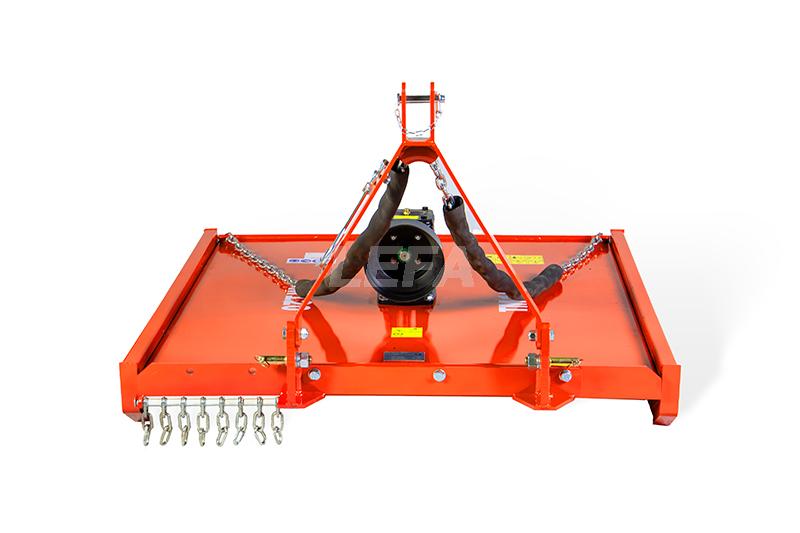
The LEFA TM topper mower range covers models from TM-90 to TM-180, with working widths from 850 mm to 1,750 mm and tractor power requirements ranging from 18 to 60 HP. This wider range allows buyers to select a mower according to tractor size, field conditions and required mowing capacity.
A topper mower is a PTO-driven tractor implement mainly used for routine grass and vegetation cutting.
Typical applications include:
· pasture and paddock maintenance;
· small farm grass cutting;
· field and property maintenance;
· controlling overgrown grass;
· mowing open areas and field margins.
For buyers who mainly need straightforward grass cutting rather than fine lawn finishing, a tractor topper mower can be a practical solution.
For dealers, the application is also relatively easy to identify. Before recommending a model, ask the customer three questions:
What is the tractor power? What working width is preferred? What type of area will the mower be used on?
These answers will usually narrow down the suitable models quickly.
Tractor power is the first specification to check when choosing a PTO topper mower.
The LEFA TM series ranges from TM-90 to TM-180, covering working widths from 850 mm to 1,750 mm and tractors from 18 to 60 HP. The following four models are common options for compact tractors in the 18–30 HP range:
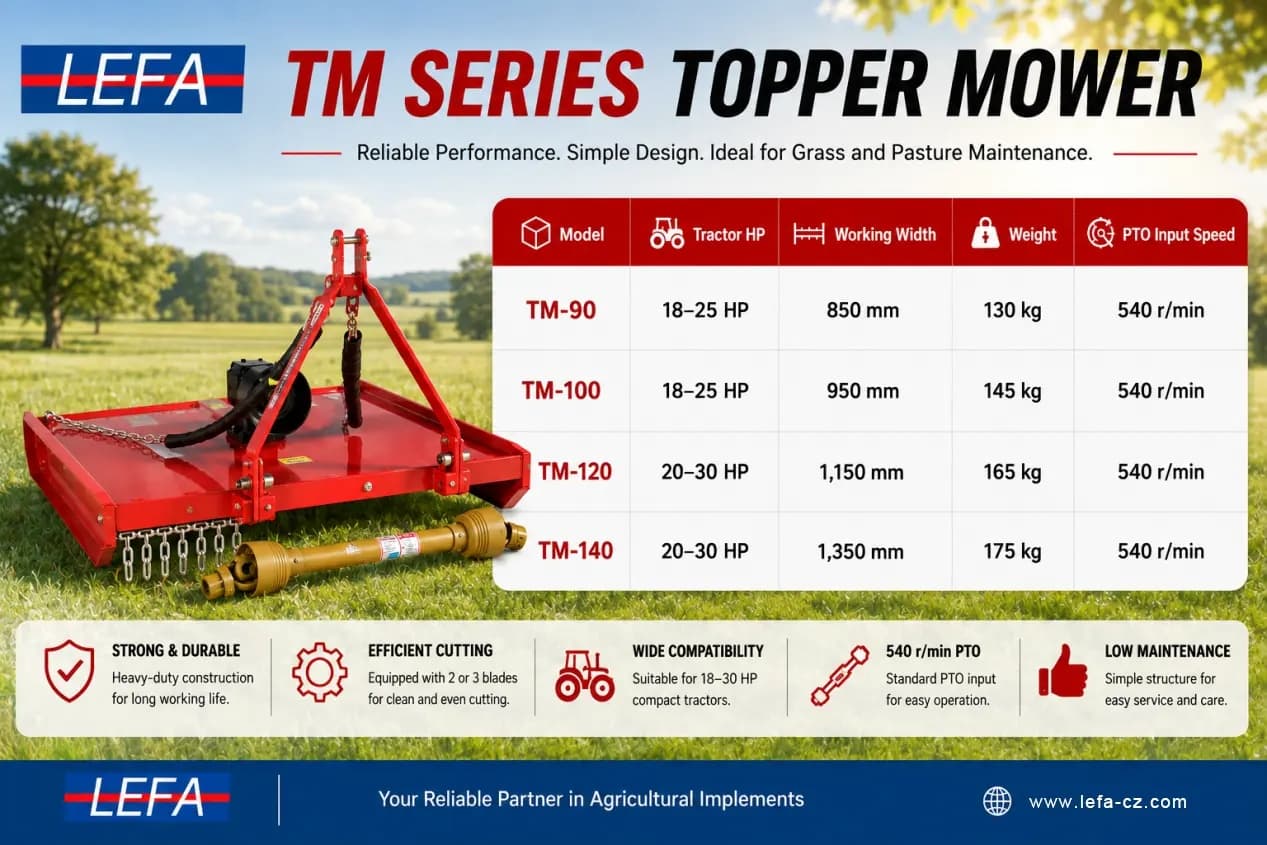
For 18–25 HP compact tractors, the TM-90 and TM-100 provide 850 mm and 950 mm working widths.
For 20–30 HP tractors, buyers can consider the wider TM-120 and TM-140, with working widths of 1,150 mm and 1,350 mm. For buyers using larger tractors or requiring greater field coverage, the TM range continues up to the TM-180, with a maximum working width of 1,750 mm and tractor power requirements extending up to 60 HP.
For the TM-90, TM-100, TM-120 and TM-140 models shown above, the PTO input speed is 540 r/min, with 2 or 3 blades depending on the model/configuration.
Tractor power, however, should not be considered alone. Buyers should also confirm the tractor's rear lifting capacity and consider working width, terrain, vegetation and field conditions before choosing the final model.
Both machines are used for field maintenance, but their cutting systems and suitable vegetation are different.
A flail mower uses multiple flails mounted on a high-speed horizontal rotor. It is better suited to grass and lower vegetation, typically weeds below about 50 cm, rather than bushes or thick-stemmed vegetation.
A topper mower uses high-speed rotary blades together with the weight of the blades to cut vegetation. It is better suited to taller grass, thicker weeds and rougher field conditions, and can also be used where occasional stones may be present.
For dealers, the key question is not simply which mower is better, but what type and height of vegetation the customer needs to cut.
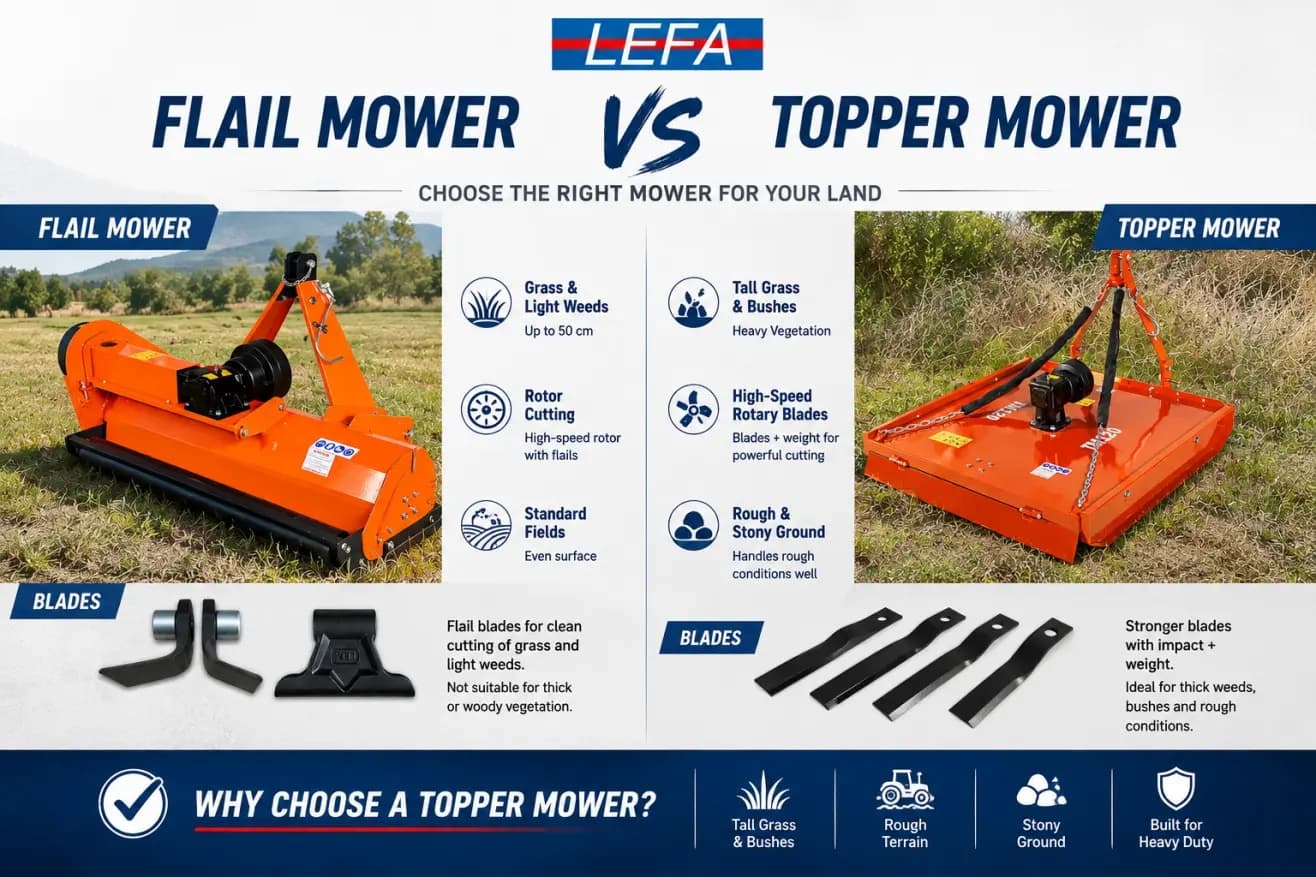
For a distributor, choosing topper mowers for inventory is different from selecting one mower for one tractor.
The first consideration should be the tractor power and working widths commonly used in the local market.
If many customers operate compact tractors around 18–25 HP, the TM-90 and TM-100 can cover that segment. For markets with more 20–30 HP tractors, the TM-120 and TM-140 provide wider alternatives. Where customers use larger tractors or maintain larger open areas, dealers can also consider wider models in the TM range, extending to the TM-180 with a 1,750 mm working width and tractor requirements up to 60 HP.
For a first trial order, distributors do not necessarily need to stock every TM model in equal quantities. A more practical approach is to build the model mix around the tractor power ranges and working widths most commonly requested by their customers.
Packaging should also be considered when calculating landed cost.
For bulk orders, LEFA topper mowers can be arranged in steel transport racks, as shown in the factory packing photos. This allows multiple units to be organized vertically for international shipment.
For mixed-model orders, the actual loading quantity should be calculated according to the selected TM model combination and individual packing dimensions, rather than assuming the same packing volume for every model.
For a 20 HP tractor, the TM-90 and TM-100 fall within the 18–25 HP range, while the TM-120 and TM-140 cover 20–30 HP tractors. The final choice should also consider tractor lifting capacity, terrain and required working width.
The LEFA TM topper mower range covers tractors from 18 to 60 HP, with models from TM-90 to TM-180 and working widths from 850 mm to 1,750 mm. The suitable model depends on tractor power, lifting capacity, field size and mowing conditions.
The TM-90, TM-100, TM-120 and TM-140 models shown in this guide use a 540 r/min PTO input speed.
A topper mower is designed for field and pasture cutting and can handle taller vegetation than the flail mower application described above. Actual performance will depend on vegetation density, field conditions and tractor power.
Not sure which TM model fits your tractor or local market? Send LEFA your tractor power, required working width and typical vegetation. We can help compare suitable models and provide packing details, mixed-model loading suggestions and dealer quotations for the TM series.
Contact LEFA for a model recommendation or dealer quotation.